
APPENDIX D
Why the Title “Tilting at Windmills”
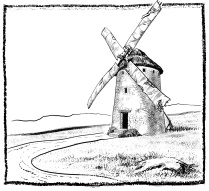
Carla considered her life’s work as one of tilting at windmills. Almost since its inception L/L has featured in its logo the ragged but valiant knight errant, his faithful squire, and the windmills at which he tilted.
What does it mean to tilt at windmills and why was that phrase chosen as the book’s title? That answer starts with the following defining excerpt:
“To tilt at windmills” is a venerable English idiom meaning to pursue an unrealistic, impractical, or impossible goal, or to battle imaginary enemies. In current usage, “tilting at windmills” carries connotations of engaging in a noble but unrealistic (usually wildly unrealistic) effort.
In Cervantes’ story, a retired eccentric obsessed with the ideals of medieval chivalry imagines himself a knight and sets out on a quest for adventure, which is made considerably more dramatic by the fact that “Don Quixote” (as the hero has dubbed himself) misinterprets just about everything he encounters. In the relevant passage early on in Quixote’s sojourn, he and his companion Sancho Panza (a dim neighbor he has recruited as his squire) encounter some windmills, which Don Quixote charges on his horse, his knight’s lance extended, believing them to be not windmills, but malevolent giants.*
L/L Research does not envision itself in precisely the way Quixote envisioned himself: encountering and battling enemies or making right the wrongs of the world for purposes of chivalry, heroism, or conferring glory on Dulcinea. Nor, for that matter, does L/L pursue extravagant and fanciful misinterpretations of the way things are. Carla speaks to this point in Chapter 2 of this book:
Carla I don’t identify with the particulars of that story, which is a peculiarly befuddled story of people that are genuinely not seeing
* www.word-detective.com/2009/03/tilting-at-windmills/
what’s in front of them . . . . I don’t think I’ve ever fooled myself about anything like that, but it’s just that desire to remain pure and true to my standards and not compromise them, regardless of how the world wags. It’s often inconvenient to do that.
Gary So what does it mean to dream the impossible dream?
Carla Well, I think it means to bring truth, beauty, love, light, and understanding to Earth, and to make it the way people live.† It’s always felt to me like the right way to live and I’ve always tried to live that way, and I know it’s impossible.
L/L Research’s dedicated work might be seen as tilting at windmills because what are we doing? We are attempting to share communication from sources much of the world’s people say do not exist. Much of the world would laugh or reject out of hand what we are doing. With good reason. Truth without proof doesn’t find many an advocate in a scientific paradigm that declares as true only that which can be measured and/or seen by its instrumentation.‡
It is not, however, only the communications and their source which highlight our windmill tilting, but also our attempt to live by principles that tend not to be the values of this world; to walk a high (albeit dusty) road of service to others, to seek qualities that many either assign little value to or simply don’t recognize. Which is not to commit the error of describing ourselves in glowing and elevated terms that set us apart—for we are most assuredly humble, error-prone, all-too-human bozos on the bus, and there are many people and many sources of light engaged daily in the good
† “Make it the way people live.” That doesn’t mean others but rather oneself.
‡ Further securing our place in the domain of the quixotic: those who call themselves the Confederation of Planets in Service to the One Infinite Creator cannot themselves be measured by scientific means. This is not to say that there is no set of parameters with which to appraise this situation. These sources of intelligence share information, perspective, and wisdom whose substance can be evaluated on its own merits—the seeker determining whether and how it may understood and applied—but, these particular beings are not manifest in our physical world or illusion. Moreover, they speak of a multi-dimensional universe, populated by infinite varieties of intelligence, unified by a one infinite creator, built of light made by love operating through free will. Though there are mystical yearnings and perspectives at the frontiers of science that recognize the fundamental oneness of the universe, no such framework as that which the Confederation offers will appear on the pages of any physics book.
work of service to others—it is only to point to a, shall I say, deeper understanding that calls to us, an understanding available always to each and every person but which few recognize or seek in this world.
Indeed it might be said that any who embark upon the quest of self-realization are tilting at windmills, or dreaming the impossible dream: the world clearly consists of countless separate parts, yet the spiritual seeker seeks unity or oneness; money not love is clearly that which makes the world go round, yet the spiritual seeker seeks to know and express the love which made, motivates, and is hidden in all things; disharmony and dispute are the ways that people and nations seem often to relate—barricaded from one another behind layers of legal, geographical, physical, armed, and/or emotional means—yet the student of the open heart seeks transparent harmony and community even, often, at the expense of the self; the world seems to teach the benefit of self-gain and the fulfilling of one’s private interests, yet the seeker desires to serve and uplift others for the gain of all; things have clearly gone terribly awry on this planet judging by the diversity of confusion, ignorance, and frequent cruelty of the world, yet she who consciously walks the road affirms that no matter the surface appearances, there is always cause for hope, there is always something to learn, and, from the greatest vantage point, all is ultimately well. These being several among many ways that conventional wisdom is honored but transcended—sometimes even defied— in the seeking of truth.
In choosing a logo for L/L Research, Carla wrote:
Don Elkins moved in with me in November of 1968. The drawing [of Picasso’s Don Quixote] was hanging over my desk and he asked about it. I told him the bare bones of the story of the man of La Mancha and how his skewed vision of the world made it a beautiful place and he, an heroic figure. He mused that it was a perfect image for the work we were then beginning to do, since we were dreaming impossible dreams together.
Since the beginning of our publishing in 1976 we have used that little image as our publishing logo. And we’re still tilting at windmills here at L/L Research with great joy and thanksgiving for the inspiration of that little sketch.
And in Carla’s 2002 speech to the International UFO Congress, she said:
Our logo is Don Quixote. Don Quixote tilted at windmills. They were all illusions, but what I care about in Don Quixote is the passion that he had for good, for honor. What I care about is the passion that Jesus had for the beauty in each one of us. He saw all of us as citizens of eternity, and that’s the truth of us. We are infinite, magical, powerful, amazing beings. We have connections to each other, to the planet, and to that beyond ourselves which we came to serve, the light.
And the way we do that is to open the heart and let that crystal radio nature work so that as we are getting the unconditional love of the infinite Creator, as the light is flowing into us, we bless it, we consciously encourage it; and we dedicate it not only to our own well-being (although we always need to do that first) but also to the lightening of planet Earth and the healing of the world. There is a tremendous need at this time for healing in this world.
All analogies and metaphors have their limitations—ways in which there is not equivalency between the two things being likened unto each other. There are such limitations in the comparison of L/L Research to Don Quixote. But among the ways that L/L Research draws upon that story (in an illustrative or at least inspiring fashion) is the way in which he uplifted himself by changing his perception and formulating a personal myth. Whether he did so as a conscious choice or as victim of an overtaking madness, the important point is that in so doing Alonso Quixano became Don Quixote and transformed his ordinary, mundane life into a quest—one built upon principles and ideals that invoked a stronger-better-more-noble version of himself—and subsequently committed his will toward that end.
In that journey Quixote’s faith informed him of what was real and actual underneath the apparent surface of things, and in that faith he stood true to his vision regardless of what the world declared otherwise. Now, the Confederation philosophy never suggests whimsically fabricating things out of thin air, but it does suggest that we generate perception as a function of our orientation (see 33.8). And it also suggests that appearances are illusory—an illusion of intelligence and purpose, but an illusion nevertheless, one that effectively hides reality from our immediate vision for the purpose of spiritual evolution.
The Confederation’s message (and the teaching of all exponents of the perennial philosophy) simply points behind the illusion to a unified, objective truth undergirding each seeker’s subjective journey. And in order to bridge the seeming distance between illusion and the one, ever-present truth, faith is absolutely required; perhaps at times even a quixotic faith. Not a faith in this or any body of material—religious, spiritual, philosophical, or otherwise—but a faith in oneself and to the Creator in all things.
Upon the path of discernment it is, of course, helpful to empirically subject one’s conclusions and ideas to scrutiny, analysis, and evidence to the contrary—because there are certainly myriad ways to create more rather than less distortion—but in the more positive and inspiring aspects of Quixote’s journey is the indomitable faith that saw something the material world didn’t, the will to commit the whole heart to its pursuit, and the inevitable follies and hard knocks upon the head that become contained in an ambiance of magic and adventure.
RA I am Ra. Your language is not over-strewn with non-emotional terms for the functional qualities of what is now termed the unconscious mind.
The nature of the unconscious is of the nature of concept rather than word. Consequently, before the veiling the use of the deeper mind was that of the use of unspoken concept. You may consider the emotive and connotative aspects of a melody. One could call out, in some stylized fashion, the terms for the notes of the melody. One could say, “a quarter note A, a quarter note A, a quarter note A, whole note F.” This bears little resemblance to the beginning of the melody of one of your composers’ most influential melodies, that known to you as a symbol of victory.
This is the nature of the deeper mind. There are only stylized methods with which to discuss its functions. Thusly our descriptions of this portion of the mind, as well as the same portions of body and spirit, were given terms such as “far-seeing,” indicating that the nature of penetration of the veiled portion of the mind may be likened unto the journey too rich and exotic to contemplate adequate describing thereof. 86.6